
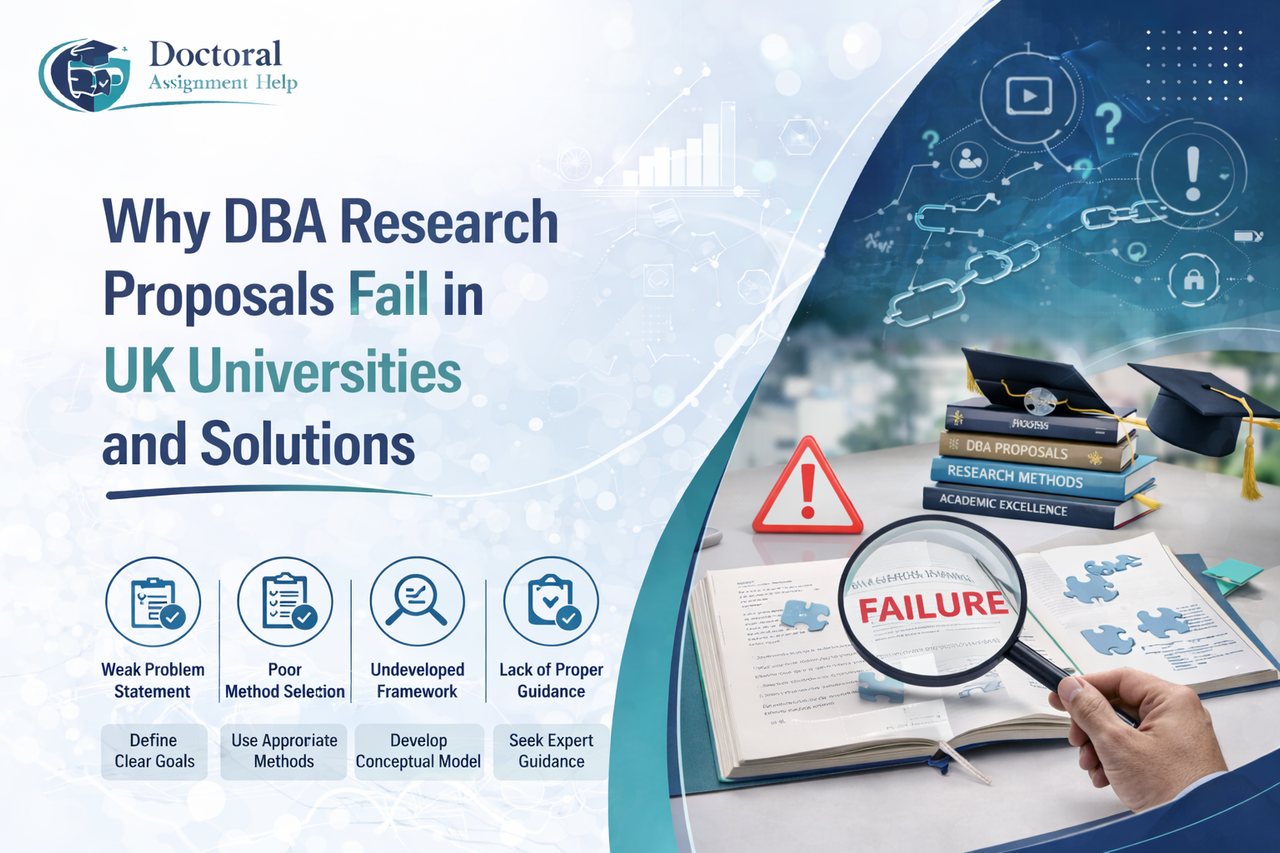
Getting your research proposal rejected is one of the more disheartening experiences in doctoral study. Especially when you’ve spent months developing the idea, reading around the topic, and drafting something you thought was genuinely compelling.
But proposal rejection in UK universities is more common than most DBA students realise before they experience it. And in most cases, the rejection isn’t about the research idea being bad — it’s about how the proposal presents, justifies, and frames that idea. Understanding why proposals get rejected is the single most useful thing you can do before submitting yours. Getting expert DBA research proposal help before submission — not after rejection — is obviously the better sequence.
Common Research Design and Methodology Errors That Lead to Rejection
Research design problems are the most frequent reason proposals fail at doctoral level in UK universities. The research idea might be interesting — but if the design doesn’t convince reviewers that the idea can actually be studied rigorously, it won’t pass.
The most common design errors:
- The research question is too broad: “How does leadership affect organisational performance?” is not a doctoral research question — it’s a topic. A doctoral research question is specific, researchable, and genuinely unanswered in the existing literature.
- The methodology doesn’t match the research question: If the question asks about employee experience (inherently subjective and contextual) and the proposed methodology is a structured questionnaire with quantitative analysis, there’s a fundamental mismatch that reviewers will immediately flag.
- No justification for methodological choices: Saying “I will use qualitative interviews” is insufficient. You need to explain why interviews rather than surveys, why semi-structured rather than fully structured, why thematic analysis rather than grounded theory. Every choice needs a rationale.
- Sampling is vague or unrealistic: “I will interview managers” tells reviewers nothing. How many? From what kinds of organisations? Selected how? A credible sampling strategy is specific, feasible, and appropriate to the research design.
- Ethics consideration is treated as a formality: UK universities take research ethics seriously. A vague paragraph about keeping data confidential doesn’t satisfy doctoral reviewers who expect to see genuine ethical thinking about consent, data storage, participant protection, and power dynamics in research relationships.
How Weak Literature Reviews Reduce Proposal Approval Chances
The literature review section of a research proposal serves a specific purpose — it needs to show that you understand the existing field well enough to identify a genuine gap, and that your proposed study will address that gap in a way that contributes something new.
A weak literature review fails at this in predictable ways:
It describes existing research without evaluating it. Summarising ten papers tells reviewers you’ve done reading. Critically engaging with them — comparing findings, identifying contradictions, evaluating methodological limitations — tells reviewers you can think at doctoral level.
It doesn’t explicitly identify the research gap. Some proposals review the literature adequately but then fail to articulate clearly what specific gap the proposed research addresses. This connection needs to be stated explicitly, not implied.
It relies on outdated sources. Business research moves fast. A literature review built substantially on studies from before 2015 in an active research area suggests the candidate hasn’t engaged with current scholarship.
Getting targeted DBA literature review help for your proposal’s literature section can make the difference between a review that convinces reviewers and one that raises doubts about your research capability.
Techniques That Strengthen Proposal Quality and Academic Credibility
A numbered framework for producing a proposal that genuinely impresses UK doctoral reviewers:
- Start with the research gap, not the topic: Before writing anything, identify specifically what existing research hasn’t adequately addressed. Your entire proposal flows from this gap.
- Write your research question last: Counterintuitively, the research question is clearest after you’ve done substantial reading and identified the gap precisely. Writing it first often produces questions that are too broad or too obvious.
- Map your methodology to your philosophy: Decide your philosophical position first — positivist, interpretivist, pragmatist — and let your methodological choices follow logically from it. This makes your justification coherent rather than arbitrary.
- Be realistic about scope: PhD proposals that try to answer five research questions or collect data from six different countries rarely pass. Doctoral research is deep, not wide. A tightly scoped, clearly feasible study is more credible than an ambitious one that can’t realistically be completed.
- Have someone else read it for clarity: If a reader can’t understand your research question, your methodology, and the gap you’re addressing after one reading — your proposal needs more work before submission.
Strategies That Help DBA Students Develop Accepted Proposals
The students whose proposals are accepted on first submission tend to share a few habits:
They engage with their supervisor early and often during the proposal development stage — sharing rough ideas, getting feedback before the idea hardens into a full draft, and being genuinely open to redirecting when the initial concept isn’t working.
They read successful doctoral proposals — often available through their university’s thesis repository — to develop an intuitive sense of what approval-ready work looks like.
They treat the proposal as an intellectual argument, not an administrative document. The proposal needs to convince an academic reader that this research matters, can be done, and will produce knowledge worth having. Every section should be written with that persuasive purpose in mind.
Conclusion
When the proposal is complete, doctoral proposal development support from experienced academic professionals who understand UK doctoral review standards can provide an honest external assessment before the official submission — catching the issues that familiarity with your own work prevents you from seeing.

